Best Arcade Games You Can Finish in One Sitting
An arcade game in a browser tab has one advantage over a console game: nobody expects you to still be there in an hour. The best ones lean into that. A run lasts ninety seconds, you lose, you immediately know why, and you go again.
What separates a good one from a bad one is almost never content. It is whether the controls tell the truth — whether the jump you saw in your head is the jump the character actually performs.
1 A run should end before you regret starting it
Pixel Dash is an endless runner with three verbs: run, jump, slide. The whole game is the timing between them. Obstacles are placed by the second, not by the pixel, so the same seed produces the same run on a phone and on a desktop.
We tested it the only way that proves an obstacle matters: by building bots that disable one mechanic at a time. With jumping turned off, the bot dies on the first spike in 24 out of 24 runs. With sliding off, it dies on the first beam. If a mechanic can be removed and the player still wins, it was decoration.
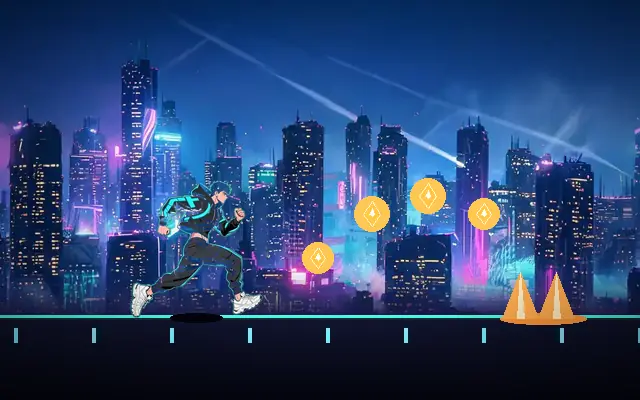 Play Pixel DashSprint the neon rooftops of a city that never ends
2 The grid is the game
Snake is a game about the space you are about to lose. Twenty by twenty cells, one apple, and a tail that punishes every greedy turn. Nothing about it needs a physics engine, which is exactly why it still plays better than most things built with one.
Our version is 285 lines and 9.4 KB. It loads faster than the page you came from, and the input queue is deep enough that a fast double-tap turns into two turns instead of a crash you did not deserve.
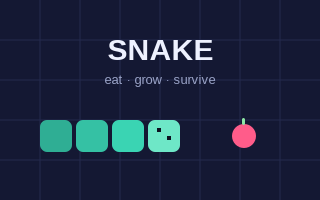 Play SnakeEat, grow, and do not bite yourself
3 One button is a constraint, not a limitation
Flappy Ball asks for one thing: tap to flap. That is the entire control scheme, and it is why the game works on a phone with no explanation. The difficulty lives entirely in the gap between pipes and the gravity constant.
Games like this fail when the hitbox lies. Ours is forgiving around the edges on purpose — a near miss should be a near miss, not a death you cannot explain.
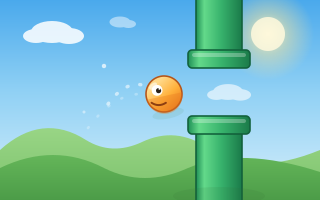 Play Flappy BallOne tap to fly, keep the ball up
4 Waves give a shooter a shape
A shooter without structure is a stress test. Space Shooter runs in waves, so the run has a rhythm: a burst of pressure, a short breath, then a slightly worse burst. That shape is what makes people say "one more" rather than "that was random".
It is also the kind of game that has to run at a steady frame rate on a five-year-old phone. Ours draws everything with the canvas 2D API and keeps fewer than a hundred objects alive at once, so there is no frame budget to fight over.
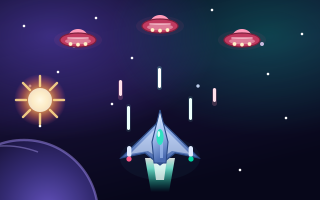 Play Space ShooterHold the line against the alien swarm
5 Local multiplayer still beats matchmaking
Two paddles, one ball, first to five. Ping Pong is the only game on this page you can play against a person sitting next to you, and it needs no account, no lobby and no connection. The keyboard is the controller; the argument about who won is included.
The ball speeds up after every rally, so a match has a natural arc instead of a stalemate. Most matches end within two minutes, which is the right length for a game you did not plan to play.
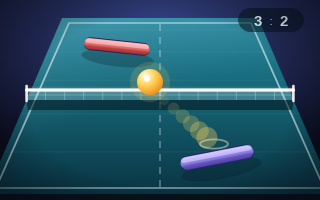 Play Ping PongFirst to 5 points takes the table
Key takeaways
For players
- Short runs are a feature: a game you can lose in 90 seconds respects your tab.
- If a near miss feels like a hit, the hitbox is lying to you.
- Local two-player is still the cheapest way to have fun on a laptop.
For developers
- Place obstacles by time, not distance, so every device gets the same run.
- Prove each mechanic matters by building a bot with that mechanic disabled.
- Keep the object count under a hundred and canvas 2D will hold 60 fps on old phones.