Best Board & Strategy Games With No Sign-Up
Strategy games are normally the ones that ask for the most: an account, a tutorial, a save file, a friend online at the same time. All five games here start in one click, and all five let you play against the computer.
That constraint is not a compromise. Playing a board game against a well-tuned AI is often better practice than playing a distracted human, and it is the only way to play at two in the morning.
1 The computer should play to win
Mini Monopoly compresses the forty-tile board onto a phone-sized square and seats up to four players, any of whom can be the computer. The AI buys, builds, trades and — importantly — goes bankrupt instead of quietly receiving a bailout.
The engineering that mattered was the economy, not the graphics. Rent multipliers by colour set, the doubling rule, mortgaging before selling, and the exact moment a player must hand over their remaining cash to a creditor: get any of those wrong and the game stops being Monopoly.
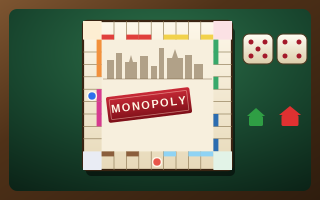 Play Mini MonopolyBuy the board, bankrupt your rivals
2 Order is the puzzle
Arrow Out looks like a tangle and plays like a scheduling problem. Every line can leave the board, but only after whatever is standing in front of its arrowhead is gone, and three blocked taps end the level. The question is never "can this move?" but "what has to happen first?"
Because a cleared line never comes back, the board is monotonic — it only ever opens up. That makes every level solvable and means the only thing you can waste is a heart, never the possibility of finishing.
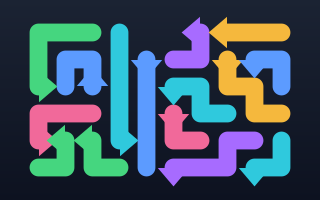 Play Arrow OutTap a line, and the whole line leaves
3 Cut the downtime
Sky Racers is a four-player race around a 52-cell ring: roll, fly a squadron, shoot down whatever is parked in the way. The classic problem with this family of games is waiting — three people watch while one person counts squares.
We measured it. Forty simulated games averaged 372 turns before we changed the finish rule to "overshoot counts as arrival" and 236 turns after — 37% less downtime per game, with no games that failed to finish. It is the least glamorous optimisation on the site and the one players feel most.
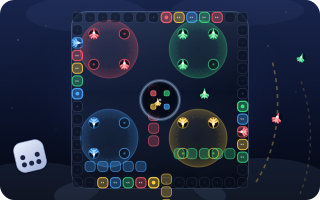 Play Sky RacersRoll, fly and shoot the other squadrons down
4 Spatial strategy needs readable space
Tank Battle puts four tanks in a maze of walls and lets them shoot each other. The strategy is entirely positional: which corridor you commit to decides whether you get a shot or take one.
Arena shooters fail visually before they fail mechanically. Walls have to read as walls at a glance, tanks have to face the way they are aiming, and a bullet has to be visible long enough to dodge. We spent more time on those three things than on the AI.
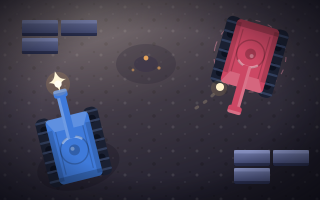 Play Tank BattleFour-tank mayhem in a maze of walls
5 Physics is a planning tool
Eight-ball is a strategy game disguised as a physics toy. Position play — leaving the cue ball where you want it for the next shot — is the whole skill, and it only exists if the physics is predictable enough to plan around.
Ours resolves collisions in sub-steps so a hard break does not tunnel through a ball, and the cue drag length adapts to how much room you have behind the ball. Small things, but they are the difference between a game you fight and a game you play.
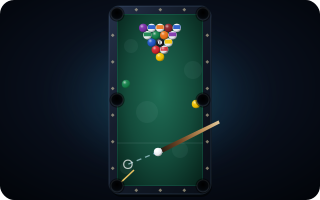 Play Neon PoolRack up and run the table — alone or two at once
Key takeaways
For players
- An AI that plays the rules straight is a better opponent than a distracted friend.
- In ordering puzzles, ask what must happen first, never what can happen now.
- Position play beats power in almost every physics game.
For developers
- Model the economy (rent, mortgage, bankruptcy) before you draw a board.
- Measure downtime, not just win rates — turns per game is a design metric.
- Cap how much of the level a player can ruin: monotonic boards never dead-end.